SME Cloud Architecture: The Shift from Legacy to Hybrid
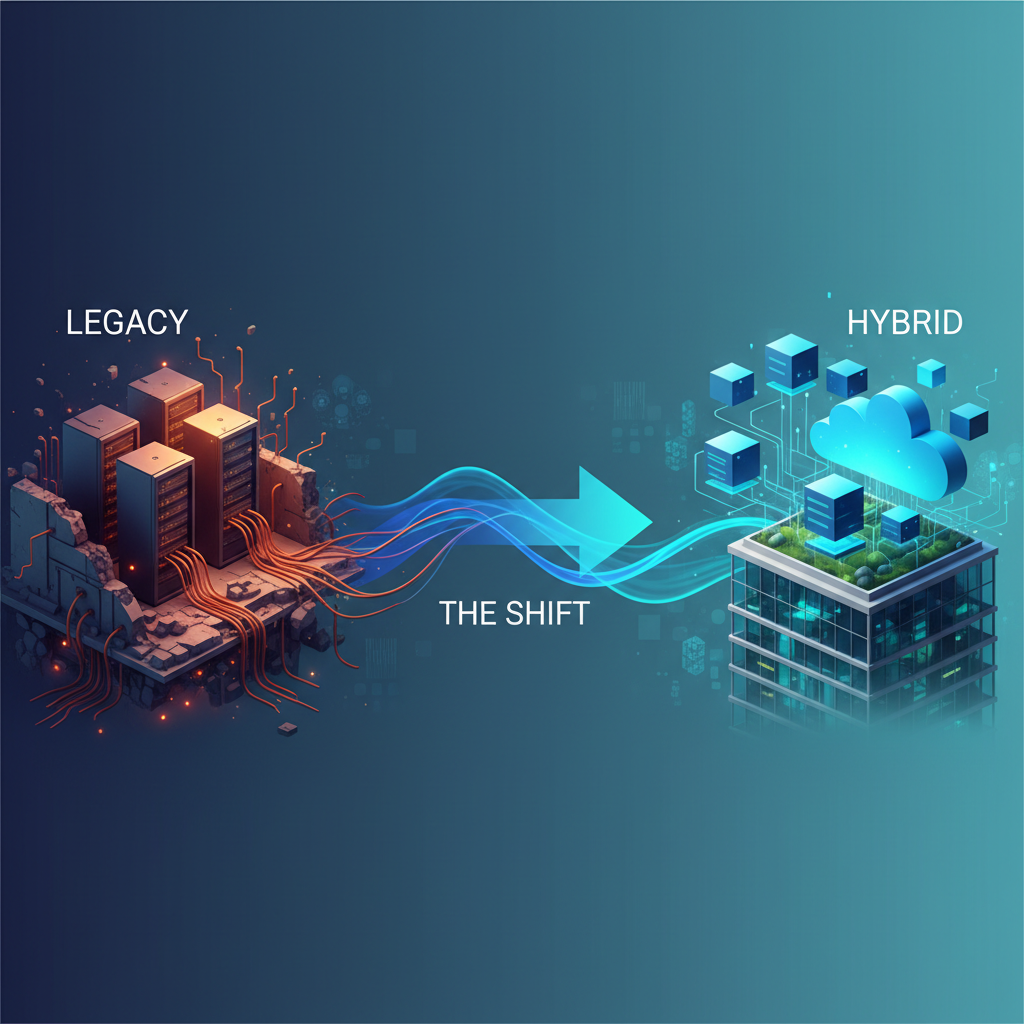
For many years, the debate for UK small and medium-sized enterprises (SMEs) was binary: do we keep the server in the cupboard under the stairs, or do we move everything to the cloud? In 2024 and beyond, that conversation has evolved. We are seeing a significant shift towards a 'best-of-both-worlds' approach. For business owners in South Yorkshire and across the UK, the challenge isn't just about moving data; it's about architecting an environment that balances performance, cost, and the specific regulatory requirements of the British market.
The Reality of the Hybrid Infrastructure
While the 'cloud-first' mantra has been dominant for a decade, many businesses still rely on legacy applications that simply don't play well with public cloud environments like Azure or AWS. We often encounter local firms with bespoke manufacturing software or high-performance CAD requirements that demand low-latency local processing. This is where hybrid cloud architecture becomes the strategic choice.
A hybrid environment allows you to keep mission-critical, high-bandwidth operations on local hardware (perhaps via a virtualised on-site server) while offloading email, collaboration tools, and backups to the cloud. The key is ensuring these two worlds talk to each other seamlessly. At Jibba Jabba, we focus on creating unified identities across these platforms so your team doesn't feel the 'friction' of switching between local and cloud resources.
Modernising the Backbone: Server Virtualisation
If you are still running one application on one physical server, you are leaving money on the table. Server virtualisation remains one of the most effective ways to sweat your hardware assets. By using a hypervisor to split one physical machine into multiple virtual servers, you reduce your physical footprint, lower energy bills—a significant factor given UK energy costs—and vastly simplify your recovery processes.
The Role of Hyper-Converged Infrastructure (HCI)
For SMEs outgrowing basic virtualisation, Hyper-Converged Infrastructure is the next step. HCI combines compute, storage, and networking into a single system. It eliminates the complexity of traditional SAN (Storage Area Networks) and allows you to scale by simply adding another 'node'. It’s an elegant solution for businesses that need enterprise-grade resilience without an enterprise-sized IT department.
The Connectivity Conundrum: SD-WAN and SASE
Your cloud infrastructure is only as good as the pipe that connects you to it. Traditional MPLS (Multi-Protocol Label Switching) circuits are often expensive and inflexible for the modern distributed workforce. We are increasingly helping clients transition to SD-WAN (Software-Defined Wide Area Networking).
SD-WAN allows you to combine multiple internet connections—such as a dedicated leased line and a secondary 5G or FTTP backup—and intelligently route traffic. If your VoIP call needs stability, the SD-WAN prioritises it. If a large file backup is hogging bandwidth, it moves it to the slower line. This level of control is essential for maintaining business continuity in an era where 'the internet is down' means 'the business is closed'.
Backup and Disaster Recovery: The UK Compliance Angle
In the UK, the Data Protection Act 2018 and UK GDPR set a high bar for data availability. It is no longer enough to just have a backup; you must have a proven recovery time objective (RTO). A robust Cloud BDR (Backup and Disaster Recovery) strategy involves more than just syncing files to OneDrive.
"A backup is a copy of data; a disaster recovery plan is a documented process for getting your business back to work."
We recommend a tiered approach: local snapshots for instant recovery of deleted files, and encrypted off-site replication to a UK-based data centre for total site failure. This ensures that even if your physical premises in Doncaster or Leeds are inaccessible, your team can spin up virtual versions of your servers in the cloud and keep trading.
Practical Steps for IT Managers
- Audit your 'Data Gravity': Identify which applications produce the most data and whether it makes financial sense to move that traffic over the public internet.
- Review your Leased Lines: With the UK's copper switch-off approaching, ensure your connectivity is future-proofed with full-fibre or high-grade cellular backups.
- Test, Don't Guess: Run a full 'fire drill' of your disaster recovery plan at least twice a year. If you haven't tested a restore, you don't have a backup.
- Focus on Latency: For businesses using cloud-hosted desktops, ensure your provider has UK-based nodes to keep the user experience snappy.
How Jibba Jabba Supports Your Journey
Navigating the transition from legacy hardware to a modern hybrid environment can be daunting. At Jibba Jabba, we specialise in auditing existing setups and designing infrastructure that scales with your ambitions. Whether you need to refresh your on-site servers, implement a secure SD-WAN, or migrate to a managed cloud environment, we provide the technical heavy lifting so you can focus on running your business. Our local Doncaster-based team understands the specific challenges UK SMEs face, from GDPR compliance to the nuances of the local telecommunications market.
Frequently Asked Questions
Related Articles



Need Expert IT & Cyber Security Support?
Get in touch and our team will help you find the right solution.
Contact Us